> For the complete documentation index, see [llms.txt](https://docs.pharos.xyz/llms.txt). Markdown versions of documentation pages are available by appending `.md` to page URLs; this page is available as [Markdown](https://docs.pharos.xyz/introduction/readme.md).
# About Pharos
*“We believe in: rough consensus and running code” - David Clark, 1992*
***
## Pharos Network Overview
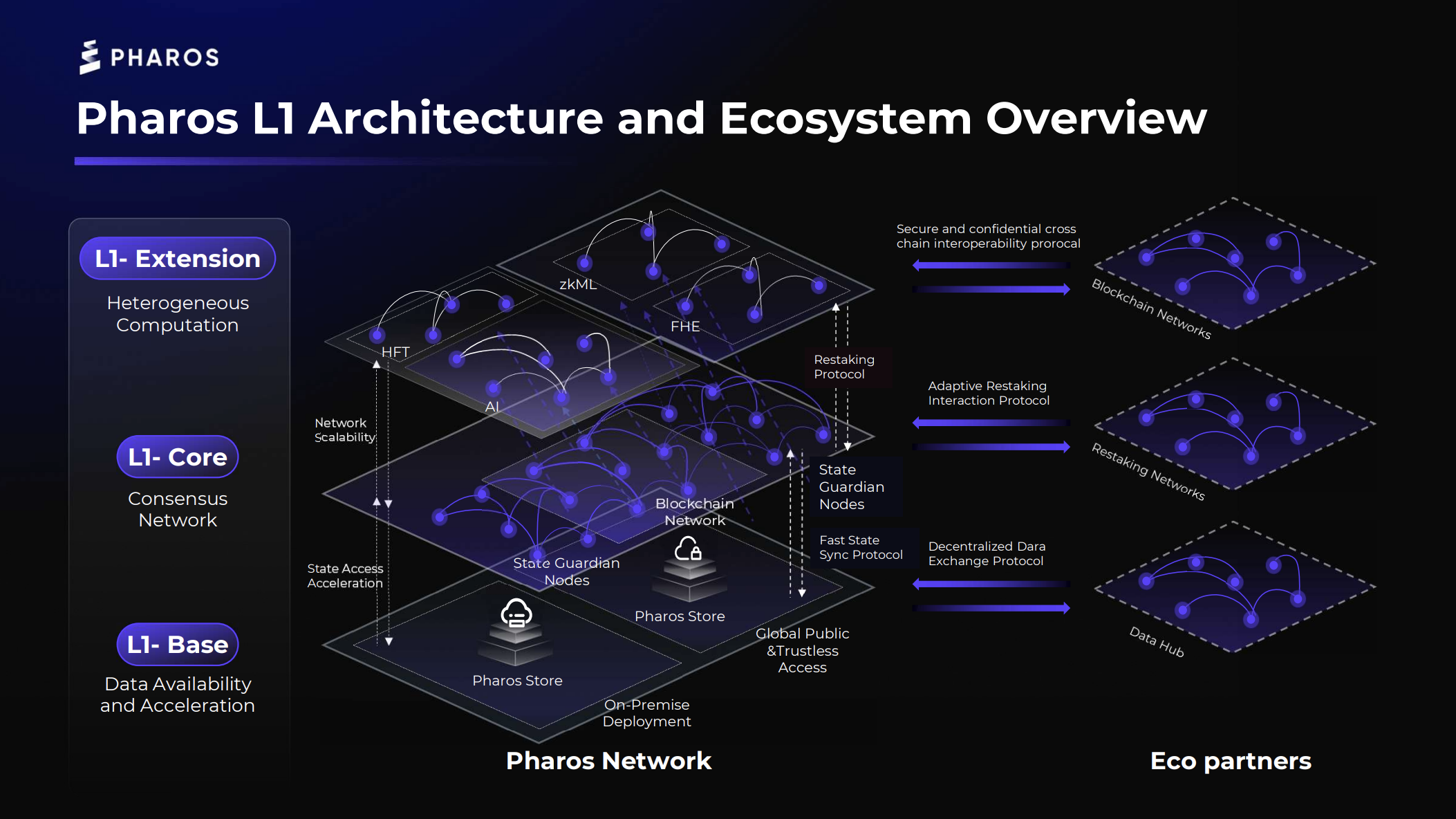
Pharos has designed a **Modular & Full-stack Parallel L1 Blockchain Network**, structured into three primary layers: **L1-Base**, **L1-Core**, and **L1-Extension**.
* **L1-Base**: Delivers industry-leading data availability and hardware acceleration.
* **L1-Core**: A high-performance, globally distributed blockchain network powered by decentralized nodes. These nodes provide high-throughput and sub-second finality, enabling real-time Web3 user experiences.
* **L1-Extension**: Built on top of L1-Core, this layer supports network expansion across three dimensions:
1. Leverages heterogeneous computation to create custom [Special Processing Networks (SPNs)](https://github.com/PharosNetwork/docs/blob/main/introduction/core-technologies/pharos-spns.md), capable of running blockchain networks, sidechains, or non-blockchain applications like **HFT**, **ZKML**, and **AI models**.
2. Enables **Native Restaking** to support rapid SPN creation, shared security, staking rewards, and slashing mechanisms. SPNs utilize the excess computing power of validators, providing flexibility in resource use while incentivizing upgrades.
3. Facilitates **Cross-SPNs Interoperation**, allowing infrastructure, middleware, and application-focused SPNs to communicate and collaborate effortlessly, fostering a highly modular and composable ecosystem.
***
## Ecosystem Architecture
The Pharos ecosystem is structured across three key layers:
1. **Transaction Layer**: Facilitates secure, confidential, and efficient cross-chain asset and account interactions via the secure and confidential cross-chain interoperability protocol.
2. **Consensus Layer**: Integrates with external restaking protocols through the **Adaptive Restaking Interaction Protocol**, enabling shared security and liquidity. This includes circulating assets like stBTC and stETH within the Pharos DeFi ecosystem.
3. **Data Layer**: Uses the **Decentralized Data Exchange Protocol** to synchronize and collaborate with external data centers, promoting innovative on-chain use cases like AI, FHE.
***
### Pharos Modular Stack
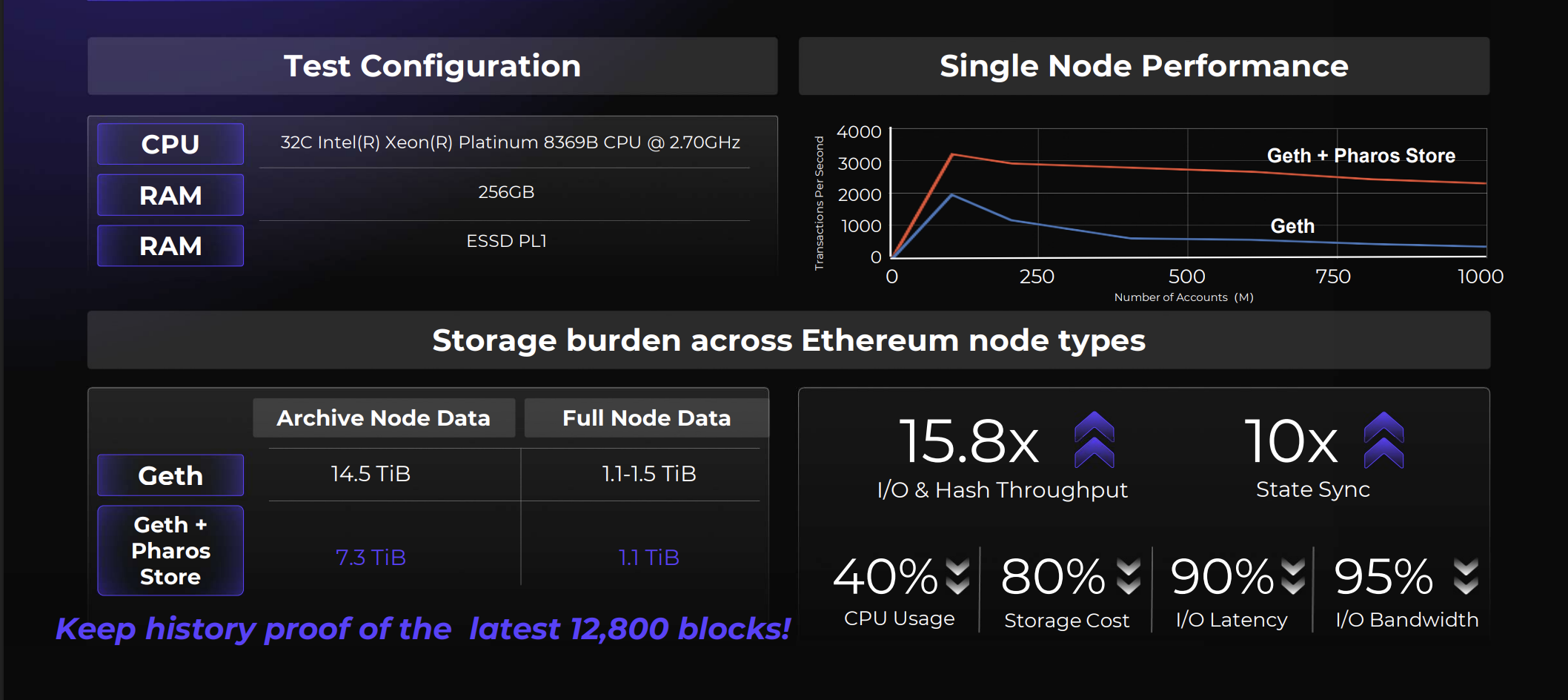
A **modular stack** is provided to support SPNs, Pharos L2/L3 systems. Each modular component is open-sourced and available to partners and developers for scaling and customization.Performance benchmarks have been demonstrated on **Geth**, and future collaborations with ecosystem partners will help drive the development of Web3 infrastructure.
***
## Restaking Integration
Pharos supports a **multi-asset protocols** to enhance security and liquidity, allowing seamless integration with restaking protocols like **Babylon** and **Eigenlayer**. Future updates will include more protocols, expanding interoperability and security across the network.
---
# Agent Instructions
This documentation is published with GitBook. GitBook is the documentation platform designed so that both humans and AI agents can read, navigate, and reason over technical content effectively. Learn more at gitbook.com.
## Querying This Documentation
If you need additional information that is not directly available in this page, you can query the documentation by asking a question.
Perform an HTTP GET request on the following URL with the `ask` and `goal` query parameters:
```
GET https://docs.pharos.xyz/introduction/readme.md?ask=&goal=
```
`ask` is the immediate question: it should be specific, self-contained, and written in natural language.
`goal` is what the user is ultimately trying to achieve, the reason they need the answer. Sharing it helps GitBook give you a better, more relevant answer. A goal is most helpful when it describes the outcome the user wants rather than restating the question. For example, with `ask=how do I create an API token`, a goal like `automate deployments from our CI pipeline` lets GitBook tailor the answer to that use case.
The response will contain a direct answer to the question and relevant excerpts and sources from the documentation.
Use this mechanism when the answer is not explicitly present in the current page, you need clarification or additional context, or you want to retrieve related documentation sections.